Livesay/ey Name
What’s in a Name?
We believe that the name LIVESAY/EY came from the Battle of Brunaburgh fought in 937 A.D. near Burnley in present day Lancashire, England. The Anglo Saxon Chronicle states that “At Brunaburgh did Aethalstan slay men all day”. Here the native people led by Aethalstan against great odds defeated the invading Danes in the valley of the Darwin River. Historians say that so great was the victory that for generations people spoke of the event with great awe. A form of the name used very early was “Leofsiege” which meant “dear victory”. The development of the spelling of the name probably progressed to Leofsy, found very early, and through various other forms to its present day variants.
More history of the Livesay/ey family will be found on the Livesay/ey History Page, in LHS publications, and in the Livesay Bulletin.
Variations
Among the variations in the spelling of the surname are:
LEAVCY, LEIVSAY, LEIVSEY, LEOFSY, LEVACY, LEVISAY, LEVISEE, LEVSAY, LIEVSAY, LIFSAY, LIFSEY, LIVASY, LIVCEY, LIVECY, LIVESAY, LIVESEY, LIVESLEY, LIVESY, LIVEZEY, LIVEZLY, LIVSEY, LOVESAY, LOVESEY, LOVESY, LUFSEY. Currently there are 9 spelling variations listed in our membership roll.
A short (and by no means complete) list of notable Livesays:
Sir Michael Livesey Sided with Oliver Cromwell and Edward Whalley in 1648 and signed a death warrant against King Charles of England.
Joseph Livesey of Walton le Dale and Preston, Lancashire, was founder of the Temperance Movement, known throughout Europe and North America. Joseph Livesay was a social reformer, publisher and one of the founding fathers of the Central University of Lancashire, located in Preston. A museum section in the university houses his publications, history and artifacts. A display of his life is also in the Preston Museum.
Levasy, Missouri Named and misspelled by the railroad, for William Wallace Livesay.
Dr. Livesey One of the heroes in “Treasure Island”, by Robert Louis Stevenson.
Dorothy Kathleen Livesay Canadian feminist and poet whose sensitive and reflective verse spanned six decades and dealt with women’s and political issues; she won Governor General’s awards for Day and Night (1944) and Poems for People (1947) and was made an Officer of the Order of Canada in 1987 (b. Oct. 12, 1909–d. Dec. 29, 1996).
Note: This list will be expanded as notable names with place of origin and a short history are submitted. Candidates for listing may be sent to the webmaster of this site or to our Historian. Please check the listing for addresses and email addre
THE LIVESEY/AY COAT OF ARMS
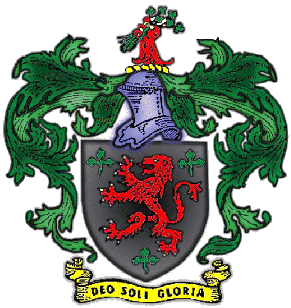
“A RED lion Rampant, with three Green Trefoils on an Argent background”
Argent is Norman French for white or silver. “The Livesey/ay Crest, which is at the top of the shield is a Lion’s Paw holding a bunch of Trefoils”
“History of the Livesey Coat of Arms: of Brunaburgh fought in 937 AD in Lancashire, England.
The known facts:
Margaret Livesey of Hacking Hall married Thomas Walmsley, (of Rishton ?) in the middle or early part of the 16th century [1500s]. Thomas Walmsley died in 1584. Thomas and Margaret Livesey
Walmsley were the parents of “Judge Walmsley”, among other children. When Margaret Livesey married Thomas Walmsley, she brought with her the Livesey Coat of Arms, to be quartered with
her husband’s Walmsley Family Coat of Arms. At the Dunkenhalgh Hotel, once the Walmsley Family home, built in 1285AD, and purchased by the Walmsleys in the 16th century, the coat of arms is displayed, including that of the Liveseys, eight quarterings in all.
This means that the Livesey Family of Hacking Hall Lancashire, England, was using the Coat of Arms at least from the late 1400s into the early 1500s. In 1613, the Coat of Arms of Livesey of Livesey Old Hall, was registered by the Heralds College, during the visitation of Lancashire by Richard St. George.
Our distant cousin, Sir Michael Livesey, the 5th signer of the death warrant of King Charles I, used the Livesey Coat of Arms of “Red Lion Rampant, Three Trefoils, Argent background, with the Crest, Lions Paw holding a bunch of Trefoils.
In March of 2003, a visit to The College of Arms, was made to research the coat of arms and copy the Livesey Coat of Arms as accurately as possible. The Livesey Coat of Arms registered with the “College” only go back to 1577, and do not mention the origin. The Livesey copy of the Coat of Arms on file does not correspond completely with the description. The Lion’s Paw is missing the
described cluster of Trefoils. Continued research is needed to add to this information. The answer may be hidden in some family treasure in an attic or museum or library. The LHS would be pleased and grateful to receive any additional information
Cousin Johanna Livesey LHS.
Note: The motto and the “drape” or decorative design cloak surrounding the coat are not specified in the Herald College description. The motto was on the Old Livesey Hall inscription
The colors, green, red, silver, signify, Sincerity, courage, hope and loyalty. Sir Michail Livesey, of East Church, Kent, was created a baronet in 1627 and was a member of the House of Commons, and used the coat of arms. Descendants of this family live in NJ.
The Livesay Historical Society uses the Coat of Arms of this family branch symbolically as the LHS logo. No claim is made of lineal descent from Sir Michael. No association or listing of the LHS logo with the British National Heraldry registry is claimed. The Coat of Arms was used by other lines of the Livesey family from earlier days as indicated in the notes listed above.